







 Português
  Español
  简体中文
简体中文 

 Premium
 Verified company


 Email
Email
 Facebook
 Whatsapp
 Twitter
 Linkedin


Description
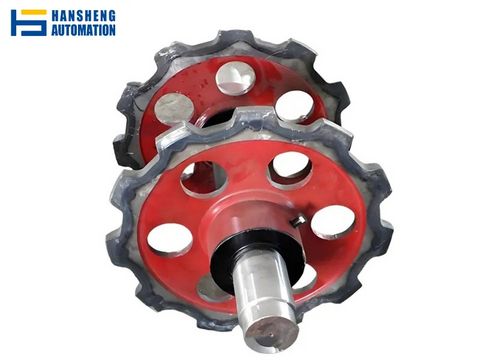
Hansheng Automation provides high-precision, wear-resistant bucket elevator sprockets. Typically used with various conveyor roller chains and round link chains, our products are widely utilized in vertical conveying systems across cement, mining, power generation, port, and grain industries. We support custom manufacturing based on your drawings or samples, with comprehensive quality control throughout the entire process.
[Core Features & Advantages]
High Machining Precision: Critical areas of our sprockets, including the inner bore, keyway, and mating surfaces, feature high machining precision (down to within ±0.005 mm). This helps ensure good concentricity between the sprocket and the drive shaft, reducing vibration during operation and extending the service life of reducers, bearings, and chains.
Excellent Wear & Impact Resistance (Hard Surface with Tough Core): Depending on your operating conditions, we utilize materials such as high-strength wear-resistant alloy steel or high-manganese steel. Combined with controlled tooth induction hardening processes, the tooth surface hardness reaches HRC 55–62, balancing high wear resistance with impact toughness.
Extensive Customization Experience: Whether you require standard-sized drive sprockets, tail sprockets, or split (segmented) sprockets designed for easy maintenance in elevated or confined spaces, we can manufacture them based on your drawings or samples to meet your equipment's installation and operational requirements.
[Key Technical Parameters & Specifications]
Product Types: Drive sprockets, tail sprockets, split sprockets, sprocket gear rings, etc.
Compatible Chains: Conveyor roller chains, round link chains, etc.
Common Materials: Wear-resistant cast steel (e.g., ZG45, ZG310-570), high-manganese steel (e.g., Mn13Cr2), alloy steel, etc.
Manufacturing Process: Lost foam casting, sand casting (and other precision casting methods) followed by machining.
Maximum Machining Size: Outer diameter 3,800 mm x Width 1,500 mm
Critical Dimension Tolerance: ±0.005 mm (Precision grinding/milling)
Standard Dimension Tolerance: ±0.01 mm (Standard milling)
Tooth Surface Hardness: HRC 55–62
Accompanying Documents: Material certificates, heat treatment reports, dimension inspection reports, etc.
[Our Manufacturing & Quality Control Process]
Technical Discussion & Design: Our engineers communicate with you to understand your equipment model, conveyed materials, and working conditions, recommending the most suitable material and structural design.
Precision Casting: We utilize lost foam or sand casting processes combined with high-precision molds to ensure a dense internal structure and mechanical properties for the sprocket blanks.
CNC Precision Machining: Utilizing large horizontal machining centers and other advanced equipment, we perform precise machining on the sprocket teeth, inner bores, and faces to ensure all critical dimensions match your drawings.
Controlled Heat Treatment: We apply induction hardening or overall tempering to the sprocket teeth, providing appropriate surface wear resistance and structural fatigue strength.
Strict Quality Inspection: Finished products are inspected using coordinate measuring machines (CMM) and other testing equipment for dimensional and geometric tolerances, ensuring delivered products comply with technical specifications.
[Typical Application Fields]
Building Materials: Cement plants, concrete batching plants (for vertical conveying of clinker, limestone, sand, etc.)
Mining Industry: Metal and non-metal mines (for lifting ores, concentrates, etc.)
Power Industry: Coal-fired power plants (for conveying coal, fly ash, etc.)
Ports & Terminals: Bulk terminals (for loading and unloading grain, ores, fertilizers, etc.)
Chemical Industry: Fertilizer plants, chemical manufacturing facilities (for conveying various chemical raw materials)
Grain Industry: Silos, feed processing plants (for vertical lifting of grains, pellet feeds, etc.)
[FAQ]
Q: How does the price of your sprockets compare to standard market options?
A: Our pricing is based on your specific specifications and manufacturing requirements. While the initial procurement cost may vary, our sprockets offer an extended service life and reduce wear on adjacent drive components. This significantly lowers downtime and replacement frequency, making them a cost-effective choice in terms of Total Cost of Ownership (TCO).
Q: What is the strength and reliability of split sprockets?
A: Through optimized structural design and high-strength connecting bolts, our split sprockets achieve strength and rigidity comparable to integral sprockets. Their primary advantage lies in simplifying installation and replacement in elevated or confined spaces, which significantly reduces maintenance time.
Q: What is the typical lead time from order to delivery?
A: The lead time depends on the sprocket specifications, structural complexity, and our current production schedule. Generally, the production cycle for standard products is about 15 working days. We will provide a more precise lead time upon receiving your specific inquiry.
- bucket elevator sprocket
- elevator sprocket
- split sprocket
- wear resistant sprocket
- drive sprocket
- tail sprocket
- cast steel sprocket
- conveyor sprocket
- bucket elevator parts
- industrial sprocket
Production Capacity:
10000
Delivery Timeframe:
Within 30 Days
Incoterms:
Not informedPackaging Details:
Not informed
More about
Hansheng Automation (Dongguan) Co., Ltd.

10-50
Employees

1
Sales volume (USD)

90%
% Export sales
Year
Established
Business type
- Industry / Manufacturer
Keywords
- Cam Indexers
- Hollow Rotary Tables
- Planetary Gearboxes
- Harmonic Drives
- Gear Manufacturer
- Custom Gears
- ISO 5 Gear Manufacturing
- High-Precision CNC Machining
- Custom CNC Machining
- Precision Castings Ver Mais
Contact and location
-
 Karim ********
-
+86 1********
-
东莞市 / 广东省 | China
 Karim ********
 +86 1********
 东莞市 / 广东省 | China
You might also be interested
-
Cam Indexer
What is a cam indexer? A cam indexer, also known as an indexer or intermittent divider, is a high-precision rotary trans
-
Custom Gear Manufacturing
Hansheng Automation is a professional custom gear manufacturer with its own production plant and ISO9001 quality managem
-
Harmonic Drive
Hansheng Automation is a professional supplier of high-precision harmonic drives. Its products boast outstanding core pa
-
Planetary Gearboxes
Hansheng Automation offers high-precision planetary gearboxes, covering eight major series: PGL, PGH, PGR, PGHR, PGF, PG
-
Hollow Rotary Tables
Hansheng Automation provides hollow rotary tables for multiple industries (medical, optical, robotics). These tables ena
-
Spline Shaft / Mop Roller Driver- High Precision (Runout ≤ 0.01mm) | OEM Factory
1. Product Introduction This precision spline shaft / Mop Roller Driver is the core drive component we have customized f
-
Sprocket Wheel
1. Product Overview We manufacture high-quality Chain Sprockets (Sprocket Wheels) for industrial transmission and convey
-
Helical Gears(customizable)
1. Product Overview We provide high-precision custom Helical Gears tailored for robotics, automation, automotive, and in
-
ISO 5 Precision Custom Metal Worm Gear
Worm Gear is one of the most common and critical components of packaging machinery. As a packaging machinery parts suppl
-
Custom Metal Spur Gear
Our Custom Metal Super Gear achieves ISO 5 accuracy (GB 5/DIN 5 equivalent) for precision transmission.engineered for no